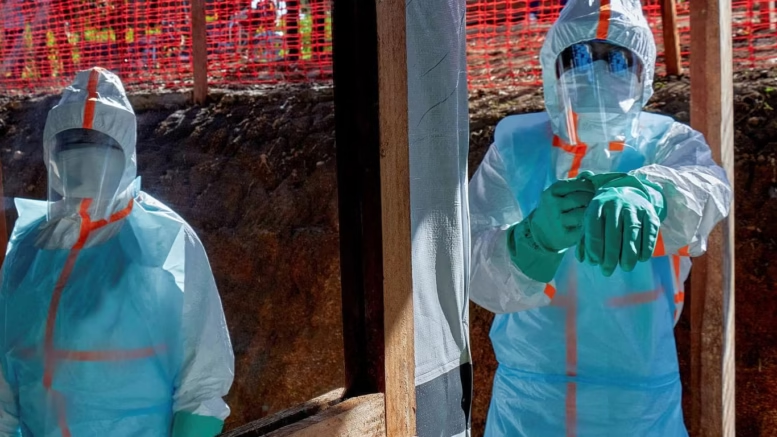
The recent Ebola outbreak in the Democratic Republic of the Congo (DRC) is presenting significant challenges in terms of treatment and prevention of the disease due to the remote area in which the outbreak began and the specific strain of virus, among other reasons.
Jonathon Gass, assistant professor of public health and community medicine at Tufts University School of Medicine and assistant professor of infectious disease and global health at Cummings School of Veterinary Medicine at Tufts University, says his main concern about this outbreak is that there aren’t any medical countermeasures established for this strain.
“There hasn’t been a whole lot of therapeutic drug development for the Bundibugyo strain as compared to the Zaire Ebola strain, which is the deadliest strain but also has a vaccine that has been validated and proven to be quite effective,” Gass says. “The reason why that’s so concerning is because all we can provide patients suffering with this infection is supportive care, which is basically the provision of fluids, oxygen, and pain treatment.”
Daniele Lantagne, a research professor at the Feinstein International Center at the Friedman School of Nutrition Science and Policy at Tufts University, and research professor in the Civil and Environmental Engineering department at Tufts University School of Engineering, is concerned about how long it might take to get this outbreak under control.
“The Eastern border of the DRC is an incredibly remote area, unreachable by car, which makes it hard to govern,” Lantagne said. “That, combined with a history of extractive colonialism in the region, disease spillover potential from people living in forested areas consuming wild animal meat, recent losses of resources from other countries, and civil unrest in the area, all make this an incredibly hard outbreak to track and treat.”
For 26 years, Lantagne has researched and educated populations on water, sanitation, and hygiene (WASH) best practices, which can prevent the spread of infectious disease. Her career has included work with the U.S. Centers for Disease Control and Prevention (CDC), where she visited countries around the world to recommend ways to keep water supplies safe by doing things like keeping feces isolated from the environment, and to practice hygiene both in the home and in healthcare settings.
Enacting those hygiene practices is vital for those providing care for a potential or confirmed Ebola patient. The virus, in this is case the Bundibugyo variant, can only be transmitted through direct contact with bodily fluids, including blood, vomit, and feces.
“The virus thrives in warm bodily fluids, and in the late stages of the disease and after death are when the body’s viral load will be the highest,” Lantagne says. “The close contact with patients at this stage of the disease, and initial misdiagnoses of other fever-presenting illnesses like malaria, is why so many healthcare workers get infected.”
Lantagne recommends that healthcare structures create separate treatment units for Ebola, which allows illnesses like malaria and dengue fever to continue to be treated in existing centers and reduces the spread of Ebola to civilians and healthcare providers.
Another way to prevent the spread is to educate residents of the region on the risk of exposure with the deceased who have died from Ebola.
“The funeral practices in this area of the DRC are very much centered around the touch of a dead body, including the washing of the body and funerals with an open casket,” Lantagne says.
Responders in the region, including the Red Cross, which produced a comprehensive implementation guide for safe and dignified burials of patients who died of highly contagious diseases, manage the bodies after death. To eliminate the spread, the bodies are placed in a body bag and family members may open the bag to see their loved one but cannot touch the body. They are then allowed to honor the deceased with a no-touch funeral, before Red Cross volunteers bury the body bag.
“These restrictions are not going over well,” Lantagne says. “Think about how your family, your culture wants to honor your body after death, and suddenly a healthcare worker says no. That’s part of the reason why Ebola treatment centers are being attacked, because of the issues around what to do with the bodies.”
Building Trust
At the root of the attacks is a lack of trust between residents of the DRC and the healthcare workers. After participating in a recent UNICEF/World Health Organization (WHO) call about the outbreak, Lantagne was reminded that the only way to build trust is by working with trusted community networks to get accurate information into communities.
“It doesn’t matter what the network is, whether it’s a religious leader, a nurse, a club,” Lantagne says. “Whatever local networks there are, they need to be activated to push fact-based scientific information through.”
That must include information about taking patients to Ebola treatment units, about changing funeral practices in some ways so that dead bodies are not touched, and about the importance of contact tracing to help establish a ring around areas with confirmed cases. Right now only about 30% of cases are being contact traced, which means the DRC outbreak is very unmanaged and it’s expected to get a lot bigger, Lantagne says.
If she could share a message with community leaders to pass on to civilians in the DRC and neighboring regions, Lantagne would make it simple.
“Ebola is real, it’s incredibly scary, and people die without treatment,” she says. “The only chance of survival will be if someone is brought to an Ebola treatment unit—and it’s still only a 50% chance of survival. And if they die, the funeral has to be adapted to be no-touch.”
After that, secondary messages would include ways to prevent transmission, like hand-washing, and what someone can expect if they’re treated for the disease.
Initial symptoms of the Ebola virus can appear within two to 21 days of exposure and typically progress from dry to wet, according to the CDC, meaning they begin with fever and weakness and are followed by diarrhea and vomiting. The generic presentation of symptoms can cause medical professionals to confuse Ebola for other diseases.
Without a vaccine, the body has to essentially fight off the infection itself. By nature, viral hemorrhagic fevers such as Ebola cause a tremendous amount of inflammation in the body, eliminating the body’s ability to clot and causing internal bleeding.
“People fall sick very, very fast, and then the hemorrhaging begins,” Gass says. “That’s why people succumb to the infection quite quickly.”
Adding to the issues facing healthcare workers is a lack of resources, specifically those historically provided by the United States as a global leader in humanitarian response and global public health.
“The disease was unrecognized for weeks, and we no longer have health experts in embassies in most of these places around the world because USAID was closed down,” Gass says. “What that means is that previously, we had health experts, outbreak experts, and infectious disease experts that were based in these countries, plus all of the medical countermeasures, stockpiles of personal protective equipment (PPE) and therapeutics for disease management in place at USAID missions. Now these rapidly deployable resources have been dismantled.”
The United States also pulled out of the WHO, which means U.S.-based scientists no longer have the same timely access to data the WHO collected in the past.
“That will definitely limit our ability to have effective outbreak responses,” Gass says. “More importantly, there’s a certain level of trust-building that is very central to global public health action. That trust has been compromised on a local, national, and governmental level as the US has changed so drastically how we engage with transboundary health crises.”
Although this outbreak will be challenging to treat, Gass thinks the danger to the U.S. is quite low, and he does not expect it to develop into a pandemic like COVID-19 due to the way it is transmitted through direct contact with bodily fluids such as vomit or feces.
Most strains of Ebola are thought to originate in fruit bats, “which are widely considered to be the native wildlife reservoir species for this genus of viruses.”
“The transmission occurs through bodily secretions, through blood, saliva, urine, or feces, and can occur in a number of ways, both direct and indirect,” Gass says. “Obviously a human having direct contact with an infected animal can happen through the process of hunting, but there are many theories about potentially being exposed by consuming contaminated fruit.”
If an infected bat takes a bite out of a piece of fruit, or urinates or defecates onto a piece of fruit, which is then consumed by a human, that human would be exposed.
Source: Tufts University