

Infection Prevention & Control
Better Sink Design Could Help Block Superbug Outbreaks
Sinks help prevent infections in hospitals but new research from Flinders University warns that contaminated basins in healthcare might put patients at risk and have implications in outbreaks of superbugs.
The Journal of Hospital Infection review compares healthcare handbasin design guidelines across 39 countries with the scientific evidence – leading to calls for better designs to reduce the risk of drug-resistant bacteria occurring, for example the commonly difficult-to-treat Carbapenemase-producing Enterobacterales (CPE).
The study found substantial inconsistencies between international healthcare design guidelines, while the limited evidence available makes it difficult to determine which design features best reduce the risk of pathogen spread, says lead author Mikaela Todarello, a PhD candidate in Environmental Health at Flinders University: “Handbasins need to support effective handwashing without creating avoidable opportunities for pathogens to spread. Microbes can build up in taps and drains. When water hits contaminated surfaces, splashing can carry them onto nearby equipment and surfaces. There is evidence that handbasin design influences how microbes spread, which means we have a real opportunity to improve these designs and reduce the risk to patients.”
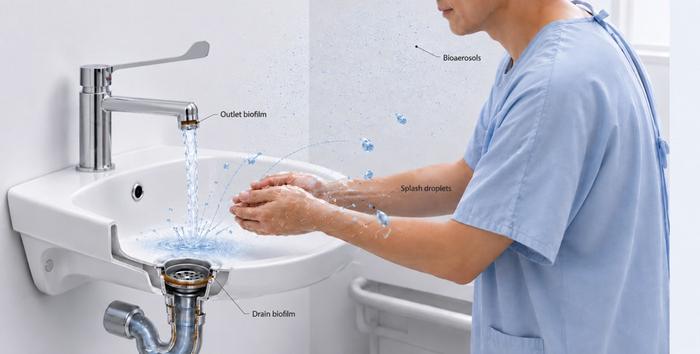
Sinks can become contaminated with pathogens from incoming water, wastewater plumbing, or during handwashing. Courtesy of Flinders University
The review identified several features that deserve closer attention:
FLAT BASIN surfaces can allow water to pool and may produce more splashing than curved surfaces, creating conditions that favor microbial growth and spread.
SHALLOW BASINS have been associated with greater dispersal of small airborne droplets, known as bioaerosols, beyond the basin than deep bowls.
DRAIN POSITION matters. When drain sits directly beneath the tap, the water stream can strike it and generate droplets and aerosols, particularly if higher pressure. Positioning the drain away from the water stream can reduce splashing.
WATER FLOW and bowl slope can change splash behavior. How a basin is positioned and used, and whether water pools in it, also need to be considered.
“There is still limited research examining how these features work together during everyday use, or which combinations best reduce infection risk,” adds Todarello. “We need to close that gap so future design guidelines are based on strong evidence from real healthcare environments.”
Harriet Whiley, professor in environmental health at Flinders University, says the findings point to a practical opportunity to strengthen infection prevention.
“We ask healthcare workers to wash their hands to protect patients. We should make sure the handbasins they use are designed with the same goal in mind,” she says. “Better engineering could reduce splashing, limit biofilm buildup and prevent contamination from spreading. We can do better, particularly in areas caring for patients who are most vulnerable to infection.”
The study – ‘Healthcare handbasin design and microbial safety: A review of guidelines and current evidence’ (2026) by Mikaela Todarello, Kirstin E Ross, Melissa H Brown, Jason Hinds, Andrew Ang, Mats Andersson, Claire Hayward, Marnie Blackburn and Harriet Whiley – has been published in the Journal of Hospital Infection. DOI: 10.1016/j.jhin.2026.08.012.
Nursing Mobile Workstations: A Reassuring Picture Overall, But the Sides and Handles Need Attention
A new Belgian study offers the first published look at microbial contamination on nursing mobile workstations — and finds that while most surfaces meet acceptable hygiene standards, certain high-touch spots are falling through the cracks.
Nursing mobile workstations (NMWs) — the wheeled carts nurses push from room to room to chart, prepare medications, perform wound care, and store supplies — are as ubiquitous in hospitals as they are easy to overlook as an infection risk. A new study published in Infection Prevention in Practice by researchers at a tertiary care university hospital in Belgium is the first to systematically quantify how contaminated these workstations actually get during normal daily use, and what that might mean for pathogen transmission.
Why the NMW Deserves Scrutiny
The researchers, led by M. Vanmeenen and colleagues, note that NMWs check nearly every box for a high-risk transmission vector. They have multiple users — nurses, physicians, support staff — creating repeated opportunities for indirect contamination via hands, especially given generally poor hand hygiene compliance. They’re used continuously for a wide range of tasks spanning clean and potentially contaminated activities, from documentation to wound care to waste disposal, raising the risk of cross-contamination between tasks. And they move constantly between nursing stations, hallways, and patient rooms, creating a physical link between different care environments.
Prior research at the same hospital had already found that hand hygiene compliance when moving from a patient to an NMW was low — just 11% — and that nurses often assume equipment has already been cleaned by a previous user, clean it only when time allows, or simply aren’t sure whether it’s been cleaned at all. Despite how obvious a transmission risk this seems on paper, the authors found no published studies had ever directly measured contamination on NMWs. This study set out to fill that gap.
How the Study Was Done
The research team sampled 30 randomly selected NMWs across 16 medical and surgical wards, collecting 150 samples total. To avoid altering normal behavior, healthcare workers were blinded to the study’s actual purpose — they were told a hospital employee was simply taking inventory of the workstations’ contents.
Samples were taken from three specific touchpoints identified in earlier observational work as frequently handled: the middle of the working surface (used for medication prep, wound care, and charting), the handle used to push the cart, and the handle of the drawer holding patient-specific medications. Flat surfaces were sampled with RODAC contact plates; the uneven drawer handle was sampled with flocked swabs. All samples were cultured and identified using MALDI-TOF mass spectrometry, with resistant organisms flagged through standard antimicrobial susceptibility testing.
Twenty workstations were sampled once, during an early shift, to capture a cross-sectional snapshot. Ten were sampled three times across the day — morning, mid-afternoon, and evening — to see whether contamination levels shifted with shift changes and cleaning routines.
What They Found
Overall, the picture was reassuring. Of the 150 samples, 82% fell into the “excellent,” “good,” or “sufficient” hygiene categories under a food-industry-derived classification system (HACCP) adapted for hospital surface sampling. Just 18% were rated “insufficient” or “poor.”
But that aggregate number masked meaningful variation by location. The working surface itself was fairly clean — 68% excellent or good — and the drawer handle was cleanest of all, with 94% of samples showing low bacterial counts. The side handle used to push the cart, however, told a different story: only 26% of samples rated excellent or good, while 44% were classified as insufficient or poor. That handle was also where most of the potentially concerning organisms turned up, including Staphylococcus aureus, Enterococcus faecium, and several Aspergillus and Pseudomonas species.
In total, 327 microorganisms were identified across all samples. The vast majority were common skin flora — Staphylococcus epidermidis, Micrococcus luteus, and Staphylococcus hominis were the most frequent finds — the kind of organisms you’d expect from routine human hand contact. Twenty-one organisms (6%) were classified as potential pathogens, including S. aureus, several Aspergillus species, and Pseudomonas strains. Importantly, none of the potential pathogens identified were resistant to antibiotics, and there was no correspondence between the organisms found on the workstations and the specific pathogens for which patients on those wards were in isolation — though the authors note three immunocompromised patients in protective isolation were on a ward where a Pseudomonas species was found on the NMW.
One finding ran counter to the researchers’ expectations. Nurses at this hospital had previously reported disinfecting NMWs at the start and/or end of their shift, leading the team to predict that contamination would dip in the mid-afternoon, right after shift change. Instead, the study found no meaningful association between contamination levels and time of day. The authors speculate that given how frequently the NMW is handled throughout a shift, any disinfection that does occur may simply not leave a lasting effect before the next round of use.
Why the Sides and Handles Are the Problem
The disparity between the relatively clean working surface and the more heavily contaminated push-handle is worth dwelling on. The authors suggest a few possible explanations: these areas may simply be harder to clean, they may be overlooked during routine disinfection because they’re less visually obvious than a work surface, or staff may perceive them as lower-priority than the areas where actual clinical tasks happen. It’s a pattern that echoes a broader theme in environmental hygiene research — the areas most touched by hands moving the equipment around are not necessarily the areas most attended to by cleaning protocols.
Compounding the issue, the study found no NMW-specific cleaning protocol existed within the hospital’s quality guidelines at all. Responsibility for cleaning different surfaces was distributed across nurses, physicians, and cleaning/logistics staff depending on infection risk category, but there was no standardized guidance on how often, or with what technique, the NMW itself should be disinfected.
Putting the Numbers in Context
The authors are careful to note that the classification system they used — borrowed from food-industry surface hygiene standards — is a stricter benchmark than at least one alternative threshold proposed specifically for hospital settings. Had they used that less conservative standard, only 3 of their 150 samples would have been flagged as insufficiently clean, rather than 23. The team deliberately chose the stricter interpretation, reasoning that because patients occasionally have contact with materials, documents, medications, or food and drink stored on the NMW, a more cautious standard was warranted.
Study Limitations
The authors are transparent about several constraints. Surface swabbing captures only culturable organisms and only a fraction of what’s actually present, and no neutralizing agent was used during sample processing — meaning the true contamination levels could be somewhat higher than what was detected. Because healthcare workers were blinded to the study, researchers couldn’t document what cleaning had or hadn’t occurred immediately before sampling. And as a single-hospital study using a sampling method with no universally accepted standard for comparison, the findings may not generalize directly to other institutions with different equipment, protocols, or staffing models.
What This Means for Practice
The bottom line the authors land on is measured rather than alarming: the overall degree of NMW contamination was reassuring, but the consistent gaps at frequently touched spots — particularly the sides and handles — represent a real and addressable target for improvement. Their recommendations for infection prevention and EVS teams include:
- Developing explicit, standardized protocols that define which NMW surfaces qualify as high-touch and specify cleaning frequency and products for each
- Repeated staff training and supervision — for nurses, physicians, and cleaning/logistics personnel alike — rather than relying on assumptions about who cleans what and when
- Considering equipment redesign to eliminate raised edges, seams, and small compartments that make thorough cleaning more difficult
- Continued emphasis on hand hygiene compliance, particularly during the transition from patient contact to NMW use, since the workstation’s risk is ultimately mediated by the hands that touch it
As the authors put it, hand hygiene remains the front line of defense — but a cart that gets pushed into every patient room, all shift long, deserves a cleaning protocol of its own, not just an assumption that “someone” wiped it down.
Reference: Vanmeenen M, Duprez V, Malfait S, Claus K, Verhofstede S, Leroux-Roels I. Microbiological contamination of nursing mobile workstations: assessing their role in pathogen transmission in healthcare facilities. Infection Prevention in Practice. 2026 Sep. doi: 10.1016/j.infpip.2026.100560.
HAI Prevalence Lower in 2023 Than in 2015 but Overall Progress Still Needs to be Made
Aug. 20, 2026
Prevalence surveys in U.S. hospitals showed that on any given day, 1 of 25 patients had a healthcare–associated infection (HAI) in 2011, as compared with 1 of 31 patients in 2015. Chea, et al. (2026) repeated the survey in 2023 to assess changes in the prevalence of such infections.
Using established methods, 10 Emerging Infections Program (EIP) sites recruited up to 25 hospitals each. Hospitals selected a survey day between May 1 and Sept. 30, 2023. EIP staff reviewed medical records of randomly selected patients to identify healthcare–associated infections using National Healthcare Safety Network definitions. The researchers described patient and hospital characteristics, compared the prevalence of HAIs in 2023 and 2015, and estimated the national burden of HAIs in 2023.
In 2023, of 13,653 patients in 218 hospitals, 355 (2.6%; 95% confidence interval [CI], 2.3 to 2.9) had at least one health care–associated infection, as compared with 394 of 12,299 patients (3.2%; 95% CI, 2.9 to 3.5) in 199 hospitals in 2015. Approximately 60% of the HAIs were not associated with devices or procedures. Among 151 hospitals in both surveys, patients were less likely to have a HAI in 2023 than in 2015, after adjustment for other factors (risk ratio, 0.73; 95% CI, 0.63 to 0.85). The researchers estimated that there were 518,000 HAIs (95% CI, 494,500 to 542,000) in U.S. hospitals in 2023.
Reference: Chea N, Rongxia L, et al. Health Care–Associated Infections in U.S. Hospitals, 2023 versus 2015. N Engl J Med 2026;395:255-266. Vol. 395 No. 3 Published July 15, 2026. DOI: 10.1056/NEJMoa2510881
Strong, Evidence-based Leadership at CDC is Essential, SHEA Says
Courtesy of CDC
July 13, 2026
The Society for Healthcare Epidemiology of America (SHEA) says it is excited that the Senate has scheduled time to review the nomination of a new director of the Centers for Disease Control and Prevention (CDC). At a time when the nation continues to face evolving public health threats, strong, trusted, and qualified leadership at the CDC is essential to protecting the health and safety of all Americans, SHEA says
“The United States stands at a critical crossroads, where evidence-based public health leadership is needed to strengthen confidence in science, guide effective responses to emerging health challenges, and ensure the nation is prepared for future threats.,” SHEA notes, adding, “The CDC plays a vital role in advancing infection prevention, antimicrobial stewardship, disease surveillance, outbreak response, and public health preparedness. Its ability to fulfill this mission depends on stable, credible leadership grounded in scientific integrity. While perspectives on public health policy may differ, the need for experienced leadership that prioritizes evidence-based decision-making and supports the CDC’s core mission remains paramount.”
SHEA says it urges the Senate to give timely consideration to the nomination of Dr. Erica Schwartz to serve as director of the CDC. “Schwartz brings the experience, expertise, and leadership necessary to guide the agency at a time when trusted, science-driven public health leadership is essential. If confirmed, she should be empowered to lead the CDC with the authority and credibility needed to strengthen the nation’s public health infrastructure and restore confidence in this vital institution. SHEA looks forward to partnering with Dr. Schwartz and the CDC to advance infection prevention, combat antimicrobial resistance, strengthen antimicrobial stewardship, and improve the health and safety of patients and healthcare personnel across the country,” SHEA says.
Source: Society for Healthcare Epidemiology of America
APIC and SHEA Appoint Subject Matter Experts to Healthcare Infection Prevention Advisory Group (HIPAG) to Advance National Infection Prevention Leadership
June 01, 2026
The Association for Professionals in Infection Control and Epidemiology (APIC) and the Society for Healthcare Epidemiology of America (SHEA) announced the official launch of the Healthcare Infection Prevention Advisory Group (HIPAG), a new national expert advisory initiative established to help ensure continuity, coordination, and leadership in infection prevention and control (IPC) expert input and collaboration across the healthcare continuum.
HIPAG was formed to help identify and address gaps in infection prevention and control expertise, and to support the implementation of clinical standards wherever healthcare is delivered. HIPAG will serve as a national resource for expertise in infection prevention and the spread of antimicrobial resistance in healthcare, helping to review and contextualize evolving evidence, identify areas requiring clarification, and support rapid-response approaches during emerging infectious disease threats and infection-related public health challenges. The group will also support alignment around evidence-based practices that enhance patient and healthcare personnel safety in acute care, ambulatory, and long-term care settings.
HIPAG Representatives
- Rebecca Alvino, RN, MS, CNS, CIC, CNOR, CRCST, FAPIC: System Director, Hospital Epidemiology and Infection Prevention, UC Davis Health
- Tania Bubb, PhD, RN, CIC, AL-CIP, FAPIC (APIC Chair): Senior Director, Infection Prevention & Control, Memorial Sloan Kettering Cancer Center
- Rashida Conway, RN, MSN, CIC: Director Infection Prevention and Control, Kaiser Permanente
- Brooke Decker, MD: VA Deputy Chief of Staff/VISN4 Hospital Epidemiologist, VA Pittsburgh Healthcare System
- Erin Epson, MD: Medical Director & Chief, Healthcare-Associated Infections Program, California Department of Public Health
- Jennifer Hanrahan, DO, MSc: Chair, Department of Medicine, Marshall University
- Claire Jai, MSc, CIC: Assistant Vice President Infection Prevention, Methodist Healthcare System & HCA Healthcare
- Lela Luper, RN, CIC, FAPIC, T-CHEST: Manager – Infection Prevention and Control, Chickasaw Nation Department of Health
- Tara Millson, DNP, RN, CIC, FAPIC: Regional Director of Infection Prevention, Medstar Health,
- Russ Olmstead, MPH, CIC: Director, Infection Prevention & Control, Trinity Health
- Cindy Prins, PhD (Vice-Chair): Associate Professor of Medicine, University of Central Florida
- Amy Spallone, MD: Chief Infection Control Officer, University of Texas MD Anderson Cancer Center
- Mike Sebert, MD: Medical Director, Infection Prevention, Children’s Medical Center Dallas UT Southwestern Medical Center
- Mike Stevens, MD, MPH, FACP, FIDSA, FSHEA: System Chief Quality Officer/ Professor of Internal Medicine/ Infectious Diseases, West Virginia University Health System/ School of Medicine
- Gabriela Andujar Vazquez, MD: Infectious Diseases Physician & Medical Director Infection Prevention, Dartmouth Health
- Sharon Wright, MD, MPH, FIDSA, FSHEA (SHEA Chair): Chief Infection Prevention Officer, Beth Israel Lahey Health
“HIPAG brings together nationally recognized experts with deep experience across infection prevention, healthcare epidemiology, antimicrobial stewardship, public health, and frontline healthcare operations,” said Kathy Ward, RN, BSN, MPH, FAPIC, CIC President of APIC. “APIC is proud to help convene a multidisciplinary group of leaders whose expertise reflects the complexity of today’s healthcare environment and the urgent need for practical, evidence-based infection prevention guidance.”
“The selection of HIPAG members reflects a deliberate effort to ensure broad scientific expertise, frontline experience, and diverse perspectives from across the healthcare continuum,” said Lisa Maragakis, MD, MPH, FIDSA, FSHEA, president of SHEA. “SHEA is excited to partner with APIC in building a trusted expert advisory group that can provide timely expert input on emerging infectious threats and public health challenges and support alignment around evidence-informed practices that protect patients and healthcare personnel nationwide.”
Additional information about HIPAG will be announced in the coming months.
The Association for Professionals in Infection Control and Epidemiology (APIC) is a professional association for infection preventionists with a mission to create a safer world through the prevention of infection.
The Society for Healthcare Epidemiology of America (SHEA) is a professional society representing physicians and other healthcare professionals in the fields of healthcare epidemiology, infection prevention, and antimicrobial stewardship.
APIC and SHEA Announce Joint Healthcare Infection Prevention Advisory Group
December 4, 2025
The Association for Professionals in Infection Control and Epidemiology (APIC) and the Society for Healthcare Epidemiology of America (SHEA) have announced a new collaborative initiative, the Healthcare Infection Prevention Advisory Group (HIPAG), to address infection prevention priorities of national importance.
The elimination of the CDC’s Healthcare Infection Control Practices Advisory Committee (HICPAC) has created gaps in coordinated, multidisciplinary alignment on infection prevention and control and antimicrobial stewardship issues, raising concerns, about potential variation and inconsistencies in organizational policies and clinical practice. HIPAG was established to help fill these gaps and ensure continuity by offering timely, evidence-informed advisory expertise that supports the needs of participating organizations and the broader healthcare community.
This initiative reflects a shared commitment to enhancing transparency, inclusivity, and scientific rigor in national infection prevention discussions.
APIC and SHEA believe that this group, which will include invited representative experts across medical societies, healthcare organizations, public health, and patient advocacy groups, will help maintain a unified approach to infection prevention as new challenges and emerging threats continue to evolve.
HIPAG is intended to prevent fragmented or duplicative efforts, promote alignment and strengthen collaboration by connecting subject matter experts across disciplines and care settings.
“HIPAG must reflect the full breadth of expertise and experience in infection prevention and epidemiology,” said David Weber, MD, MPH, FIDSA, FSHEA, FRSM, president of SHEA. “We are inviting expert representatives from key medical, public health, and patient groups to ensure broad and inclusive engagement across disciplines. Evidence-informed infection prevention policies save lives—there’s no room for compromise. We owe it to our patients and our field to get this right.”
“APIC is proud to partner with SHEA and our colleagues across healthcare and public health in this essential initiative,” said Carol McLay, DrPH, MPH, RN, CIC, FAPIC, FSHEA, 2025 APIC president. “HIPAG reflects our shared commitment to ensuring that infection prevention remains science-driven, practical, and grounded in real-world expertise. This collaboration is not only critical to the safety of healthcare delivery—it is key to restoring trust and confidence among patients, families, and the professionals who care for them.”
HIPAG’s structure and membership will be finalized in the coming weeks, along with a coordinated communication and engagement plan.
Organizations interested in participating in or contributing to expert representatives are encouraged to contact APIC or SHEA for more information.
Source: SHEA