

Manufacturers’ Instructions for Use (MIFUs)
This feature is the cover story of the Sept-Oct 2026 edition of Healthcare Hygiene magazine.

PROBLEMATIC IFUS UNDER SCRUTINY
EVS is Named in the Definitions but Missing from the Decisions in APIC’s New MIFU Toolkit
By Kelly M. Pyrek
For years, the infection prevention community has wrestled with problematic manufacturers’ instructions for use (MIFU) that complicate the cleaning, disinfection and even sterilization of medical devices, instruments and equipment. The Food and Drug Administration (FDA) began regulating device labeling in a formal sense in 1976, but it began directly and systematically addressing problematic or confusing MIFUs through human-factors work around the late 1990s and early 2000s, particularly with guidance issued in 2000 and 2001. The FDA increasingly addressed whether device users could understand and safely follow labeling through human-factors and usability engineering. This reflected recognition that unclear instructions could contribute to errors and patient harm.
A watershed report released in 2000 — Medical Device Use-Safety: Incorporating Human Factors Engineering into Risk Management — explicitly connected device design, instructions, user error, and safety. The next year, the FDA issued Human Factors Principles for Medical Device Labeling, providing more specific guidance on making device labeling—including instructions for use—clear and usable. In the 2000s onward, the issue became especially explicit in guidance on reusable and reprocessed devices. For example, FDA guidance required reprocessing instructions to be comprehensive, technically feasible, and validated with representative healthcare users.
As we know, MIFUs are the official directions and information supplied by the equipment or device manufacturer explaining how to use a healthcare device safely and correctly. They typically include the device’s intended purpose and users; set up, installation, and operating procedures; safety warnings, precautions, and contraindications, cleaning, disinfection, sterilization, and maintenance instructions; troubleshooting guidance; storage and transport requirements; applicable accessories or consumables; disposal instructions; and technical specifications and, where relevant, servicing or calibration requirements.
It’s a significant amount of information to comprehend and follow, but the IFU is the manufacturer’s authoritative reference for operating the equipment as intended and reducing risks to patients and users, and is non-negotiable. Every IFU is built on validation testing conducted by the manufacturer (or an accredited lab on its behalf) to demonstrate that a device or chemical performs as claimed only under specific, tested conditions. Change any one of those conditions — dilution, contact time, temperature, water quality, device disassembly steps — and the manufacturer’s validation no longer applies. Non-adherence to MIFUs has serious consequences; for example, from a patient safety perspective, not following MIFUs could result in inadequate disinfection and/or sterilization, which increases HAI and cross-contamination risk. From a regulatory standpoint, surveyors from the Joint Commission, CMS, and states cite facilities for undocumented deviations from IFUs, and repeated IFU-related findings can affect accreditation status and public reporting. There is additional legal liability, in that manufacturer warranty and liability protection may not apply if the IFU was not followed.
There is shared accountability for IFUs in the healthcare setting. IFU compliance is not the singular responsibility of sterile processing or EVS departments; rather, infection prevention validates that policies reflect current IFUs, while EVS and SP personnel execute the daily tasks. Further, supply chain/value analysis ensures that new products come with accessible IFUs before purchase; and facility leadership ensures staff have time, training, and tools to comply. This program is built around that shared ownership model.
Source: APIC
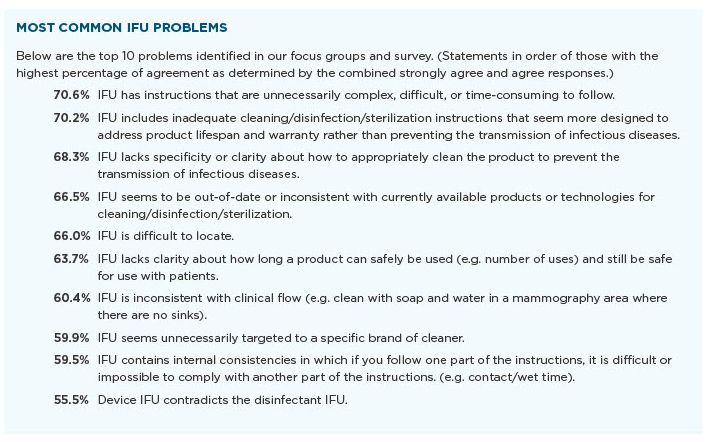
The MIFU Pain Points
Outside of MIFUs in the sterile processing and environmental services departments, the pain points experienced by clinical users — nurses, physicians, and techs at the bedside — that have been most consistently documented are numerous. They include:
– Volume and format overload. IFUs for even moderately complex devices routinely run dozens to 100-plus pages, and clinical staff report simply not having time to read them in full during a shift. This is the single most cited friction point in usability literature and FDA’s own human factors guidance was written largely to counter it.
– Fragmented, inconsistent presentation across manufacturers. A nurse working with infusion pumps, monitors, and point-of-care devices from five different vendors encounters five different IFU structures, icon systems, and warning conventions — there’s no cross-industry standardization, so pattern-recognition skills built on one device don’t transfer to the next.
– Instructions validated in lab conditions, not real workflow conditions. This is the core lesson of the 2015 duodenoscope crisis extended to general clinical use: formative and summative usability testing happens in controlled settings, but real bedside use involves interruptions, time pressure, multitasking, and environmental noise that testing protocols don’t fully replicate.
– Poor accessibility at the point of use. Paper IFUs get lost, are stored centrally rather than with the device, or are outdated versions; electronic IFUs (eIFUs) solve some of this but introduce new problems — requiring a workstation or mobile device mid-task, unreliable Wi-Fi in some clinical areas, and multi-click navigation to find one specific instruction.
– Frequent revisions without effective communication. Manufacturers update IFUs for regulatory or design-change reasons, but hospitals don’t always have a reliable mechanism to push those updates to frontline staff — so clinicians may be working from a mental model built on an earlier version.
– Role-blind instructions. FDA’s own human factors guidance recognizes nurses and physicians as distinct user groups with different tasks and training, yet many IFUs are written as a single generic document rather than role-specific guidance — burying the handful of steps a nurse actually needs inside content meant for a biomedical engineer or physician.
– Alert and warning fatigue. IFUs are often larded with boilerplate warnings and contraindications (partly a liability-driven practice) to the point that critical, use-specific warnings lose visual and cognitive priority — the same “trigger fatigue” phenomenon well-documented in EHR and clinical decision support research.
– Literacy and language mismatch in diverse clinical workforces. Especially relevant in your outlet’s audience: IFUs are rarely tested for comprehension across the full range of English proficiency and health literacy levels actually present in a hospital’s clinical staff, not just a “typical” reference user.
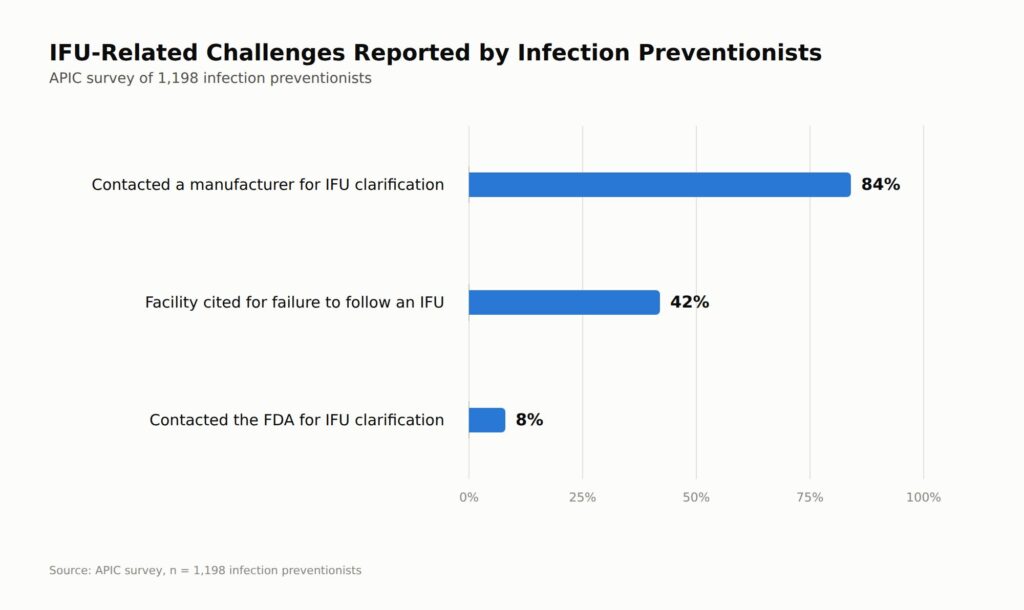
In 2023, nearly 1,200 infection preventionists participated in APIC’s first comprehensive research effort assessing adherence to manufacturer-provided instructions for medical devices, equipment, and products, and presented results at that year’s annual conference.
Source: APIC
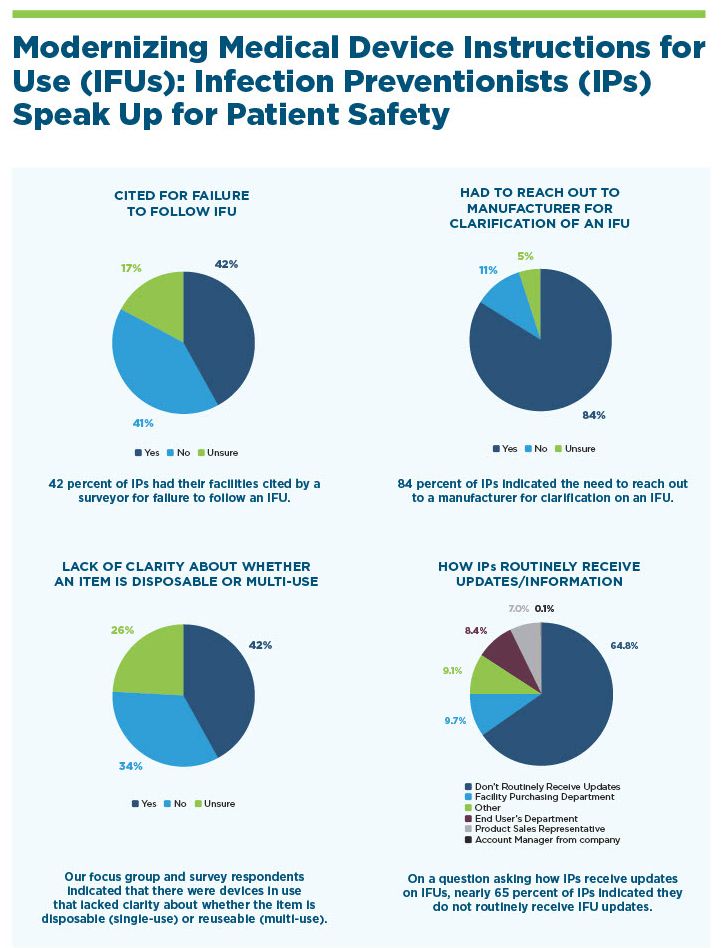
Published in May 2024 as “Modernizing Medical Device Instructions for Use (IFUs): Infection Preventionists Speak Up for Patient Safety,” 42 percent of responding IPs said their facility had been cited for failure to follow an IFU, 84 percent had contacted a manufacturer for clarity on cleaning, disinfection, or sterilization, and 8 percent had contacted the FDA to clarify an IFU. Only 35 percent of those cited were able to successfully contest the citation, and 70 percent said MIFUs convey more concern for product lifespan and warranty than for infection prevention — a finding that lands squarely on environmental services. APIC characterized bluntly as an unacceptable burden that undermines efforts to prevent healthcare-associated infection transmission.
APIC issued its call to action in these steps:
1. Develop tools to help IPs and other healthcare personnel navigate the current less-than-optimum process, for cleaning, disinfection, and sterilization of medical instruments.
2. Bring problematic IFUs to the attention of manufacturers and the FDA.
3. Educate policymakers and healthcare organizations about flaws in the current regulatory framework that limit IPs’ ability to protect patients from transmission of HAIs via medical devices.
4. Convene stakeholder organizations to work with APIC to propose a new regulatory framework for cleaning, disinfection, and sterilization of medical devices that includes (but is not limited to):
– A standardized format for IFUs;
– IFU language which takes into account the needs of infection prevention and control, sterile processing, environmental services, and end users to protect patients;
– Device labels which are easily accessible to users for the duration of the product’s lifespan, indicate when the IFU was last updated, and provide information on who users may contact in case of questions;
– A public repository for IFUs so that users will have access to appropriate information for devices that are no longer manufactured and/or when the manufacturer is no longer in business.
Source: APIC
The MIFU Toolkit
Building on that survey data, in May 2026 APIC released Guidance for Addressing Problems with the Manufacturer’s Instructions for Use: A Toolkit for Non-Critical Devices, designed to help facilities manage IFUs that are unclear, conflicting, or impractical. APIC’s 2026 president Kathy Ward framed the core problem as IPs being routinely put in the position of operationalizing instructions that don’t reflect real-world workflows or current evidence.
The toolkit itself provides a systematic framework for reviewing non-critical device MIFUs, assessing risk, and documenting decisions aligned with infection prevention principles and regulatory expectations — including a decision-support algorithm and templates. A follow-up “IP Insight Panel” webinar featuring the toolkit’s authors dug into real-world application, common challenges, and practical implementation strategies across healthcare settings.
The MIFU toolkit — prepared by APIC’s 2025 Practice Guidance Committee with support from APIC’s Center for Research, Practice, and Innovation — is algorithm/template-based, reviewed by four accreditors (AAAHC, ACHC, CIHQ, and DNV but not the Joint Commission), and scoped narrowly to non-critical devices and low/intermediate-level disinfection.
The toolkit has some limitations. Most notably, there is no Centers for Medicare & Medicaid Services (CMS) imprimatur, so it is not binding conditions of participation (CoP) guidance. The Toolkit does admit in a disclaimer that it is “provided for general informational purposes only,” “does not constitute professional, regulatory, accreditation, legal, or clinical advice,” and carries no “representation, warranty, or guarantee that the guidance, recommendations, or examples contained in this document will satisfy the standards or expectations of any specific accrediting or regulatory organization.” That said, AAAHC, ACHC, CIHQ, and DNV are all CMS-approved accrediting organizations with deeming authority. When three or four of them review a tool, it tends to surface in surveys whether or not CMS has blessed it, so “persuasive authority only” understates its practical force.
Because it has only been in the marketplace for a few months, the toolkit is unproven in practice and has no track record yet. It could be said that the toolkit is symptom-management, not root-cause, as it doesn’t fix manufacturer IFU quality or surveyor inconsistency challenges, and it does not address the one consensus standard that specifies what a non-critical device IFU must actually contain — ANSI/AAMI/ISO 17664-2:2022, Processing of Health Care Products: Information to be Provided by the Medical Device Manufacturer for the Processing of Medical Devices, Part 2: Non-Critical Medical Devices.
Within a regulatory context, the Food and Drug Administration (FDA) establishes IFU validity premarket for the device types that require a submission; however, roughly 95 percent of Class I devices are exempt from premarket notification, so for much of what EVS touches, FDA reviews no IFU at all. FDA also retains post-market authority over labeling changes, adverse-event reporting under 21 CFR 803 (which includes mandatory user-facility reporting, meaning hospitals are themselves reporters for device-related deaths and serious injuries), safety communications, and recalls.
CMS enforces IFU adherence at the facility level under 42 CFR 482.42, cited at Tag A-0749 — a tag that survived the 2019 rewrite of the infection control CoP but now maps to §482.42(a)(2) rather than (a)(1), with current interpretive guidance issued in QSO-22-20-Hospitals and revised again in QSO-25-24-Hospitals. The frequently cited Hospital Infection Control Worksheet dates to 2015 and predates all of it; surveyors work from Appendix A.
The Joint Commission requirement is the one most directly on point, and it is new. IC.02.02.01, for years among the entity’s most-cited standards, was retired July 1, 2024. Its replacement, IC.04.01.01 EP 4, requires “cleaning, disinfection, and sterilization of reusable medical and surgical devices in accordance with the Spaulding classification system and manufacturers’ instructions,” the use of “EPA-registered disinfectants for noncritical devices and equipment according to the directions on the product labeling, including … indication, specified use-dilution, contact time, and method of application,” and — critically — “resolution of conflicts or discrepancies” between manufacturers’ instructions. TJC’s guidance does not authorize deviating from an IFU. Where a disinfectant and a device IFU are incompatible, it directs organizations to contact the device manufacturer’s technical service group, contact the disinfectant manufacturer about compatibility, and identify and mitigate residual risk where compatibility cannot be established, weighing liability, warranty, and device life.
The Joint Commission’s absence from the toolkit is surprising, as this accrediting body carries the most specific conflict-resolution requirement on MIFUs.
The Application to Environmental Services
In general, MIFUs apply to environmental services (EVS) through the non-critical device framework, because most of what EVS personnel clean and disinfect are surfaces and equipment that require cleaner-disinfectants.
For EVS, the IFU that matters most day to day is the disinfectant/cleaning product label and its associated safety data sheet (SDS). Surface disinfectants are EPA-registered, and their label carries the same legal weight as a device IFU.
The most common objects, surfaces and equipment that EVS personnel encounter daily that have MIFUs attached to them include hospital beds, overbed tables, couches, mattresses, and chairs (plus other items made of vinyl or other soft surfaces), confirms EVS expert Michael Parker, CMIP, T-CHEST, T-CSCT, CMPS, T-CNACC, of Parker & Parker Consulting and a member of the advisory council of the Environmental Services Optimization Project (EvSOP).
These items fall into the non-critical category of the Spaulding Classification, which calls for low- or intermediate-level disinfection, rather than the critical and semi-critical categories that drive the sterilization and high-level disinfection typically handled by the sterile processing department. The distinction matters, as Spaulding sorts devices into three categories, while disinfection describes four separate processes, and collapsing the two is how conversations about MIFUs could go wrong.
Parker says he believes the average EVS professional may not fully understand what MIFUs are and why they matter, with various barriers to comprehension. “For many years, our furnishings were not challenged, and now people are looking for safer, healthier, more sustainable products. Most EVS staff don’t know what to do or have time to research.”
That demand, he notes, now collides with the need to kill a broader range of pathogens and spores. Killing those microorganisms generally takes more aggressive chemistry, not less. EVS is being asked to go gentler and more lethal at the same time, and nobody has informed the frontline how to be both.
“We have to up our game,” Parker says. “And most people do not start the conversation with, ‘How does this affect my furniture, its warranty or its life?’ Yet they are the right questions. Compatibility, warranty and service life all ride on which product a facility picks to meet a broader kill claim. EVS techs know what the wrong answer looks like — a cracked mattress cover, a tacky chair arm, a bed rail with the finish wiped away — and a replacement request landing on the same budget that had no room for a second disinfectant.
He says it is also an accreditation exposure. He explains that the Joint Commission’s requirement that furnishings and equipment be kept safe and in good repair, and that interior spaces be safe and suitable for the care provided, now sits in the new Physical Environment chapter — PE.01.01.01, “the hospital has a safe and adequate physical environment” — after Accreditation 360 dissolved the Environment of Care chapter on January 1, 2026. A cracked mattress cover is simultaneously a chemical-compatibility failure and a survey finding.
Parker characterizes the toolkit as not being very useful in EVS day-to-day work. “The market is flooded and manufacturers simply don’t respond. There is no easy-to-find information or contact information. It also does not address the inconsistent cleaning steps in the MIFUs.”
Parker says he has been working on a project to streamline cleaning instructions across manufacturers; of 48 manufacturers contacted, only three have responded so far. One company said it costs too much to perform additional testing, Parker reports.
Asked how EVS departments should translate MIFUs into policies, procedures, and actual performance at the cart, Parker says it all starts with comprehensive review. Parker advises EVS personnel to “Complete a detailed reading of the MIFUs because some are assumed to be straightforward but when read they have extra steps. Create a matrix for your surfaces and keep it updated; review it with any new purchases.”
“This is a perfect reason we need to have the right people sitting at the table,” Parker continues. “At the recent AHE annual meeting I spent time with IPs who didn’t know you should unzip a mattress cover to inspect the core. Every person on the care team has a job — let’s work together, with each expert weighing in.”
The Toolkit’s EVS-related Gaps
The toolkit’s central gap is structural. Every decision and action step in the algorithm belongs to the infection preventionist, and environmental services appears exactly once in the entire document — in a definition. Around that are related gaps in authorship, EVS expertise, and realities related to operations and implementation.
The toolkit’s EVS coverage gets thin when examining the authorship and review roster, comprised of IPC experts, with no visible EVS voice and no one with CHESP, CSCT or T-CSCT, CHEST, or CMIP — the certifications and certificates that mark EVS expertise. That is in contrast with the CDC STRIVE environmental services training modules hosted by APIC — four modules developed by APIC subject matter experts and, in APIC’s own words, “reviewed by subject matter experts from the Association for the Health Care Environment (AHE).”
AHE’s absence from APIC’s MIFU Toolkit’s review panel is conspicuous given how squarely non-critical device/surface disinfection sits in EVS’s operational lane. The precedent matters more than the correction; APIC has already demonstrated that it knows how to bring AHE in when the content belongs to EVS, and did so on federally funded work. AHE’s absence from the MIFU toolkit’s review panel is conspicuous given how squarely non-critical device and surface disinfection sit in EVS’s operational lane. Whether AHE was invited and declined, or was never approached, is a question neither organization has been asked on the record.
A second gap is that the toolkit is framed as an IPC-driven decision tool, not a frontline EVS one, a choice that the document does not explain. APIC describes it as a systematic framework for reviewing MIFUs for non-critical devices, assessing risks, and documenting decisions aligned with infection prevention principles and regulatory expectations, built to help infection preventionists evaluate discrepancies, collaborate with multidisciplinary teams, and determine appropriate next steps. That is a decision-authority framework sitting with the IP; however, EVS is typically the department executing the daily cleaning and disinfection activities, and personnel encounter confusing or conflicting instruction in real time on the floor. At best, the toolkit positions EVS as a stakeholder to be “collaborated with,” not as a co-owner of the resolution process.
Specifically, the toolkit indicates that every decision and action step is IP-driven, such as “IP reviews,” or “IP requests and retains documentation,” or “IP contacts manufacturer’s technical service group,” or “IP does not recommend device or equipment.” The only place a broader team enters is the fallback step which states, “IP proceed with education and collaboration with multidisciplinary team,” but that is a generic, undefined “multidisciplinary team,” not EVS specifically. The algorithm is structurally a solo-IP decision tree with an unnamed committee as an escape valve.
Further, the toolkit blurs — or doesn’t clearly distinguish — device MIFUs from surface/environmental disinfectant IFUs, an important distinction for nursing and EVS accountability. It frames the shared problem as problematic MIFUs for low- and intermediate-level disinfection broadly, and notes flexibility applies to non-critical equipment that requires low-level disinfection specifically. However, “non-critical device cleaning” (such as a glucometer’s MIFU) and “environmental surface disinfection” (an EPA-registered disinfectant’s label instructions for a bed rail or overbed table) are governed by different documents and in part, different regulatory bodies (FDA device labeling versus EPA/FIFRA product labeling).
The overlap is messy. A disinfectant labeled to process noncritical medical devices and equipment surfaces is itself an FDA Class I device under 21 CFR 880.6890 and an EPA-registered antimicrobial; a product labeled only for floors and walls is EPA’s alone. One aspect drives much of the frustration on the floor — an EPA label is legally enforceable against the user under FIFRA, where use inconsistent with the labeling is a violation, while a device MIFU reaches the hospital only indirectly, through CMS and the accreditors. It’s not clear from the material whether the toolkit’s algorithm accounts for that distinction, or whether it was built device-first and surface disinfection is just assumed to fit the same logic.
Additionally, material compatibility is not an afterthought in the document — it is asked for twice. The section on evaluating MIFUs lists “assessment of material compatibility with existing products (e.g., cleaners and disinfectants) used by the healthcare facility” among the things a multidisciplinary team should confirm, and step three of the risk-assessment process directs the IP to “review the MIFU of the disinfectant(s) and their compatibility with device and equipment materials.” The toolkit asks the question in two places and supplies no method, no data, and no source for answering it. An IP who follows the instruction has nowhere to go except back to the manufacturer that wrote the problematic MIFU in the first place.
A significant gap is that there is no visible operational-feasibility testing against EVS-encountered realities. The toolkit’s real-world examples are described in IP risk-assessment terms, with no indication the examples were stress-tested against EVS staffing ratios, turnover-time pressure between patients, or the reality that EVS technicians are following standardized standard operating procedures (SOPs) across an entire facility rather than making device-by-device judgment calls. A risk-assessment algorithm that assumes IP-level time and clinical judgment may not translate cleanly to a discharge-cleaning workflow with a time budget.
Additionally, the toolkit lacks real-world examples involving EVS-related scenarios. Every example in the document is a clinical/patient-care device, evaluated from a clinical-use-error angle rather than a cleaning-operations angle, such as a blood pressure cuff (the toolkit’s primary example), physical therapy/rehab gym equipment, incubators and warmers in the NICU, and glucose meters. None of these are EVS-owned equipment (floor machines, UV-C or no-touch disinfection systems, textile/linen processing equipment) or scenarios framed from an EVS operational perspective (such as “the MIFU’s dwell-time instructions don’t match EVS’s turnover workflow”). All examples are framed as “how does IP evaluate this device,” with EVS-adjacent tasks (again, actually cleaning the item) treated as background execution rather than a stakeholder decision point.
It would appear there is no stated feedback loop back to the EVS department, meaning nothing in APIC’s public description addresses how a documented MIFU-discrepancy resolution gets translated into updated EVS-directed SOPs, training, or competency verification once the IP has made the call. The toolkit appears to stop at “IP documents a defensible decision;” the step that would ensure the EVS technician’s actual practice changes accordingly is not addressed. The problem here is that the EVS department is being treated as an input to IPC decisions rather than a named clinical discipline with its own seat at the table.
A disadvantage is that the toolkit’s templates lack an EVS sign-off or notification field. Currently, both appendix documents have a single generic field: “Multidisciplinary team”/”Key participants,” asking for “names of staff and roles present for discussion.” There is no dedicated line item for EVS, no required sign-off field, and no notification checkpoint distinct from the general team-roster blank. Whether EVS is in the room is left entirely to whoever fills in that blank. When the toolkit populates that field with a real name-and-role roster, the 10 roles listed are: Hospital Epidemiologist/Medical Director, Director of IPC, CNO, Chief Safety Officer, CMO, Materials Management, Risk Management, Regulatory, Nurse Manager, and Health Technology Management/Biomedical Engineering. EVS is absent from that list, despite EVS personnel being the ones who would actually execute the cleaning/disinfection change under discussion. The risk-assessment example’s “Key participants” field has just “End-users and infection prevention,” “QAPI committee,” and “Governing body.”
The one place EVS does appear is a single line, in the definitions section, listed as an example of who might sit on a multidisciplinary team: “infection preventionists, nursing, nursing [sic], materials management, supply chain, environmental services, quality, safety…” And once in the risk-assessment process, where step five directs the IP to “perform a multidisciplinary review by interviewing and collaborating with representatives from relevant healthcare facility departments, including the end-user of the device, environmental services, biomedical teams, risk management, and/or legal counsel, if applicable.” That is the full extent of EVS’s presence in the toolkit — named once as an example of a team member, and once as a department to be interviewed. Both are consultative. Neither is a decision point, a required sign-off, or a notification checkpoint, and neither appears anywhere in the algorithm or on either template.
As of press time, no independent critical or academic analysis has pointed out the EVS-in-name-only pattern in the toolkit’s structure. No organization in the EVS realm has taken a public stance on the toolkit. For a document only a few months old, that is unsurprising rather than surprising. As stated previously, there is no apparent involvement by AHE in the toolkit, nor has it commented on the MIFU issue in any statements or position papers; MIFU compliance does not appear in AHE’s Practice Guidance content overview, its white paper portal, or any position statement located for this article.
However, one session at the recent annual AHE conference addressed MIFUs directly. “Manufacturers’ Instructions for Use – Is Compliance Possible?” acknowledged the practical difficulty rather than presenting a solved problem. Hosting the session is not the same as taking a position, and AHE has not taken one.
The session’s title is notably more skeptical and ground-level framing than APIC’s toolkit language (which frames the problem as “structured” and “resolvable” with the right framework). APIC’s toolkit presents MIFU conflict as a process problem with a documentable solution, while the AHE session title suggests the EVS-side experience of it is closer to an open question.
Whitney Casey, MHA, MBA, BBA, BA, senior manager of product portfolio and clinical success for a disinfectant manufacturer, was a co-presenter of that session and confirms that EVS personnel encounter numerous products with MIFUs – but may not be aware of them.
“This will vary by facility, but we often see things like hospital beds, infant warmers/incubators, bedside patient monitoring, nurse call buttons, patient tables, bedside patient monitors, and other equipment that remains in the patient room after patient discharge,” she says. “These items are often cleaned and disinfected by environmental services or housekeeping as part of room terminal cleans prior to the next patient’s arrival to that room. Most of these items are considered medical devices that are regulated by the FDA and would have instructions for use that would have reprocessing instructions associated with them.”
She explains that there is a very common misconception about manufacturer’s instructions for use and what they do and do not include. “In conversations with healthcare workers, there is often an assumption that the cleaning and disinfecting products listed in the MIFU represent the only cleaning and disinfecting products that are compatible for use with the device and that they represent the cleaning and disinfecting products that are most effective at killing pathogens of concern related to the use of their product,” Casey says. “This is not necessarily true. The FDA labeling guidance instructs device manufacturers that they should only include cleaning and disinfecting agents that were used in validation studies. This means that the only ones they list are ones they tested.”
She continues, “The limitations are that they are not required to test every cleaning/disinfecting products available, they are not required to keep pace with new cleaning/disinfecting products introduced to the market after original device clearance (meaning older devices will have older cleaning/disinfecting products listed on their MIFU), they are not required to choose best in class cleaning/disinfecting products that have the most efficacy claims or are the safest for use, and the level of validation that is done for cleaning and disinfecting the device can vary by FDA class of device.”
Casey walked through the FDA’s device-classification framework in her presentation at AHE. FDA device classes are based on risk associated with the type of device as it relates to its intended use. “They range from Class I to Class III devices. The highest risk class of device is Class III devices and they require a full Pre-Market Approval (PMA) submission to the FDA to review a full set of data including things such as clinical data and instructions for use. Class III devices tend to be things like cochlear implants, implantable defibrillators, and other high-risk items. You would not typically find a Class III device being something that EVS staff would come into contact with in their daily work or be things that they would clean and disinfect.”
She continues, “The lowest risk class of devices are Class I and Class I Exempt. This represents about 47 percent of all medical devices. These are items that are more likely to be included in EVS staff responsibilities. For these devices based on FDA Label Guidance, “… if thorough cleaning is adequate (non-critical devices unlikely to be sources of cross-transmission or soiled by body fluids), it may be returned to service …” after cleaning alone.1 In addition, Class I and Class I Exempt devices often do not have their IFUs reviewed and approved through the FDA.”
Casey adds, “Class II devices fall in the middle and are required to submit a 510(k) for review and approval by the FDA. One of the things that is typically submitted is the MIFU. Some of these devices may fall under the responsibility for EVS staff to clean and disinfect. For these devices it’s important to understand that Class II devices are not typically subjected to testing of their cleaning/disinfecting processes and recommended products against a broad scale list of pathogens. Some manufacturers may validate against one or a small number of pathogens; but, you’re not likely to find devices that have had their cleaning/disinfecting subjected to many pathogens. This is part of the reason you don’t typically see efficacy studies published by medical device manufacturers unless they are the manufacturer of a disinfectant product.”
She emphasizes as a side note, that high-level disinfectants and sterilants are considered FDA Class II medical devices and require evidence that they can meet kill specific classes of pathogens. Low- and intermediate-level disinfectants — those most often used by EVS — are FDA Class I medical devices and fall under the U.S. EPA for approval of efficacy claims. Efficacy testing for low and intermediate level disinfectants is conducted under lab conditions in test labs certified to handle infectious agents. These products require that each pathogen be separately tested and achieve passing results to be included on the disinfectant’s EPA Master Label.
Casey emphasizes that these points can lead to confusion over whether cleaning and disinfection instructions in MIFUs address compatibility of the cleaning and disinfecting products with the device in question, address ability to kill a broad range of pathogens of concern for healthcare organizations or do a combination of both.
“For many items being cleaned and disinfected by EVS staff, the extent of testing and validation of medical devices can often be more focused on materials compatibility and not fully cover elimination of pathogens of concern that truly make the device safe for reuse on the next patient,” she says. “Many device manufacturers rely on the disinfectant manufacturers to be able to show evidence of pathogen kill claims for their disinfecting products. (Not to be confused with disinfectant manufacturers being able to provide compatibility with the materials of construction for the medical device. Since device manufacturers do not typically reveal the materials of construction for their devices and can change that over the life of the product, disinfectant manufacturers cannot make definitive statements about their disinfectant’s compatibility with any particular device.) At the end of the day, medical device manufacturers typically do broader materials compatibility testing and disinfectant manufacturers typically do broader testing of pathogen kill claims under laboratory conditions for their disinfectant.”
Casey says the APIC MIFU Toolkit has played an important role in helping healthcare organizations identify, collect, and evaluate manufacturers’ instructions for use. “One area for future growth may be providing additional guidance on multidisciplinary decision-making,” she notes. “MIFU-related decisions rarely impact a single department; they often involve competing priorities across infection prevention, EVS, nursing, biomedical engineering, quality, risk management, supply chain, and healthcare leadership. Helping organizations bring these perspectives together in a structured way could support more transparent, balanced, and defensible decisions when patient safety, staff safety, clinical effectiveness, workflow, and resource considerations do not perfectly align.”
She says that MIFUs are an important input into the decision-making process, but they should not be viewed as the only factor driving policy and procedure development. “Healthcare organizations must balance multiple priorities simultaneously, including regulatory compliance, patient safety, staff safety, clinical effectiveness, operational workflow, equipment preservation, training complexity, and available resources,” Casey says. “One of the biggest challenges organizations face is that compliance on paper does not always translate into compliance in practice. The healthcare environment is complex, and policies that appear achievable when written may become difficult to execute consistently across hundreds of devices, multiple departments, varying staff experience levels, and real-world workflow constraints. As a result, organizations are often forced to navigate competing priorities and determine which approach will provide the greatest overall benefit while minimizing unintended consequences.”
Instead, Casey says, “What appears to work best is when organizations establish a structured, multidisciplinary process for evaluating MIFUs and making risk-based decisions. Bringing together stakeholders from EVS, infection prevention, nursing, biomedical engineering, supply chain, quality, and risk management helps ensure decisions account for both compliance expectations and operational realities. Organizations that struggle are often those that attempt to evaluate MIFUs in isolation or assume that every recommendation can be implemented exactly as written without considering the broader impact on patient care delivery, staffing, workflow, and resources. Ultimately, MIFUs should inform decisions, but they should be integrated into a structured framework that helps organizations transparently evaluate trade-offs, document rationale, and select the approach that best aligns with their clinical and operational goals.”
In her presentation at AHE, Casey addressed a real-world problem commonly encountered in the healthcare setting.
“In our study of 565 MIFUs for medical devices and disinfecting wipes that represented 85.5 percent of wipes sales by medical distributors in 2025, we found that the highest compliance level that could be achieved when using a single wipe would be 44.4 percent,” Casey says. “We also reviewed a sample list of select IFUs of concern that were provided to us by 10 hospitals in the U.S. For those hospitals, we reviewed an average of 29 MIFUs for each facility. For those facilities to be 100 percent compliant it would require that they use seven different disinfecting wipe brands. In other words, for every four to five MIFUs evaluated, it would require a different wipe. Knowing that your average hospital has significantly more than 29 devices, it is structurally improbable that they could achieve 100 percent compliance without excessive use of resources, be it financial or staff related. The question therefore becomes less about whether an organization can achieve perfect compliance and more about how it should make defensible decisions when perfect compliance is not feasible.”
She continues, “This is where healthcare organizations need a disciplined decision-making process. Rather than asking, “How do we comply with every MIFU?” leaders may need to ask, “How do we balance patient safety, staff safety, device longevity, workflow, clinical efficacy, regulatory expectations, and available resources in a transparent and defensible manner?” Organizations that establish a formal process for evaluating these competing priorities are often better positioned to explain and justify their decisions than those that simply attempt to comply with individual MIFUs one at a time. Ultimately, the challenge is not achieving perfect compliance with every individual instruction. The challenge is creating a transparent and defensible process for evaluating trade-offs when important organizational priorities compete.”
The Vacuum the Toolkit Fills
One piece of context makes the toolkit’s existence easier to understand. CDC’s Guideline for Disinfection and Sterilization in Healthcare Facilities, published in 2008 and updated in June 2024, remains the field’s foundational document. In May 2025, CDC terminated the Healthcare Infection Control Practices Advisory Committee (HICPAC) that would ordinarily revise it, over objections from APIC, SHEA, IDSA, and PIDS. With no federal advisory committee positioned to update the guideline, no regulatory fix to MIFU quality in sight, and the one consensus standard that governs non-critical device instructions sitting untouched, professional associations are writing the guidance instead. That is the vacuum APIC’s toolkit is filling, and it is a reasonable thing for a professional association to do. It also points to a professional association writing the guidance in absence of a federal entity, and who sits at the table for this guidance-development process matters a great deal more than usual.
References:
FDA. A History of Medical Device Regulation & Oversight in the United States. Accessed at: https://www.fda.gov/medical-devices/overview-device-regulation/history-medical-device-regulation-oversight-united-states
FDA. Overview of Device Regulation. Accessed at: https://www.fda.gov/medical-devices/device-advice-comprehensive-regulatory-assistance/overview-device-regulation
FDA. Reprocessing Medical Devices in Health Care Settings: Validation Methods and Labeling. 2015.
1. Reprocessing Medical Devices in Health Care Settings: Validation Methods and Labeling Guidance for Industry and Food and Drug Administration Staff. Issued March 17, 2015. Appendix E updated June 9, 2017. Retrieved from page 35 of https://www.fda.gov/media/80265/download
When the Instructions Fail: A History of FDA and Stakeholder Efforts to Fix Problematic Manufacturer Instructions for Use
For nearly three decades, a quiet but consequential argument has run through medical device regulation: manufacturers are legally required to tell healthcare workers how to clean, reprocess, and safely use their devices — but “telling” and “being understood” have never been the same thing. The history of how the FDA and its stakeholders have wrestled with inadequate Instructions for Use (IFUs) is really three overlapping stories — one about reprocessing, one about patient comprehension, and one about human factors design — that periodically collide, usually after patients have already been harmed.
The Foundation: Labeling Without a Usability Standard
The Medical Device Amendments of 1976 gave FDA its authority over device labeling, later codified in 21 CFR Part 801 (general labeling) and Part 809 (in vitro diagnostics). These regulations answered *what* had to be disclosed — intended use, warnings, directions — but said little about whether the intended user could actually follow them. For twenty years, “adequate directions for use” was treated as a content checklist, not a usability standard.
The first crack in that assumption came from reprocessing. As reusable surgical instrumentation grew more intricate through the 1980s and ’90s, AAMI published Technical Information Report 12 in 1994 — “Designing, Testing, and Labeling Reusable Medical Devices for Reprocessing in Health Care Facilities” — an early acknowledgment from industry that reprocessing instructions deserved their own design discipline. FDA followed in 1996 with reviewer guidance on the same subject. Neither had real regulatory teeth yet.
The Reprocessing Reckoning (1999–2002)
Teeth arrived with the single-use device (SUD) reuse controversy. Hospitals had been reprocessing devices labeled “single use” for decades, operating in a gray zone the FDA had largely left alone. That changed as the practice scaled into a commercial third-party industry, and questions about patient safety, informed consent, and equitable oversight came to a head.
FDA and AAMI cosponsored a conference on SUD reuse in May 1999. A proposed regulatory strategy followed that November, refined through a teleconference and then an open public meeting convened in Rockville on December 14, 1999. That meeting — drawing device manufacturers, reprocessors, hospital associations, and central service/sterile processing stakeholders — became the basis for a cascade of guidance:
– February 2000: draft guidances on risk categorization and enforcement priorities for reprocessed SUDs
– August 14, 2000: final guidance, “Enforcement Priorities for Single-Use Devices Reprocessed by Third Parties and Hospitals,” which for the first time treated hospitals and third-party reprocessors as *manufacturers* — subject to the same registration, quality system, and labeling obligations as the original equipment makers
– July 30, 2001: final guidance, “Labeling Recommendations for Single-Use Devices Reprocessed by Third Parties and Hospitals” — the document that made labeling itself the named subject, requiring reprocessed devices to be clearly identified as such
Congress cemented this framework into statute with the Medical Device User Fee and Modernization Act of 2002 (MDUFMA), which mandated that reprocessed SUD labeling identify the reprocessor and required validation data for roughly 70 device types. For the first time, “who wrote adequate reprocessing instructions” was a matter of federal law, not just professional norms.
The Patient-Labeling Track (2000–2015)
Running in parallel, FDA turned attention to labeling written for laypeople rather than clinicians. A draft guidance in March 2000, informed by CDRH qualitative research into patient and caregiver comprehension, was finalized in April 2001 as the “Guidance on Medical Device Patient Labeling.” It pushed manufacturers toward plain language, logical sequencing, and literacy-appropriate design for brochures, leaflets, and instructional videos aimed at patients and home caregivers.
By 2015, FDA judged the guidance overdue for revision and convened a two-day public workshop at its White Oak campus to gather fresh stakeholder input — an explicit acknowledgment that comprehension standards from 2001 hadn’t kept pace with emerging media formats, human factors science, or the sheer growth of home-use devices.
Human Factors Enters the Picture (2000–2016)
The third track reframed the entire problem. Rather than asking “did the manufacturer write it down,” human factors engineering asked “can a real user, under real conditions, actually do it correctly.” FDA’s first guidance on this, in 2000, was modest. A 2011 draft revision took years to finalize — but when it did, on February 3, 2016, “Applying Human Factors and Usability Engineering to Medical Devices” fundamentally changed the burden of proof. Manufacturers were now expected to document use-related risk analysis, run iterative formative testing, and complete summative validation testing with representative users — testing that directly assesses whether the IFU itself, not just the device, supports safe and effective use. An inadequate IFU is no longer just a comprehension problem; it’s evidence of a failed design process.
Where the Tracks Collided: The Duodenoscope Crisis
If there’s a single episode that shows why this history matters operationally, it’s the duodenoscope outbreaks of 2015. A 2011 draft guidance on reprocessing validation and labeling had sat unfinalized for four years when reports surfaced of CRE (carbapenem-resistant Enterobacteriaceae) infections — including deaths — tied to duodenoscopes at UCLA’s Ronald Reagan Medical Center and other facilities. Investigators found something worse than a labeling gap: bacteria were surviving even when reprocessing staff followed the manufacturers’ instructions exactly as written.
FDA expedited the stalled guidance, finalizing “Reprocessing Medical Devices in Health Care Settings: Validation Methods and Labeling” on March 12, 2015, with six explicit criteria for adequate reprocessing instructions. Warning letters went to all three major duodenoscope manufacturers that August. By October, FDA had mandated real-world postmarket surveillance studies to test whether reprocessing instructions actually worked outside controlled lab conditions — not just whether they existed.
The episode produced ANSI/AAMI ST91, a dedicated flexible-endoscope reprocessing standard, and fed directly into the 2016 human factors guidance’s emphasis on validating labeling with actual device complexity in mind, not idealized use cases.
The Present Moment
Recent developments continue to push in the same direction: FDA’s 2013 rule permitting electronic IFUs for certain facility-based professional devices; The Joint Commission’s 2023 reprocessing guide, issued after 2022 survey data found more than half of hospitals noncompliant with core sterilization and disinfection standards; and the February 2026 harmonization of FDA’s Quality Management System Regulation with ISO 13485, folding labeling controls more tightly into the broader quality system. The throughline across fifty years of rulemaking is consistent: every major tightening of IFU standards has followed a documented failure, not preceded it.
Deep Dive: Ramifications for Sterile Processing
No group has absorbed the practical weight of this regulatory history more directly than sterile processing professionals — the technicians and departments responsible for actually executing manufacturer reprocessing instructions, often under time pressure, with instrumentation whose complexity has consistently outpaced the clarity of its labeling.
The instructions were never really written for them: For much of this history, reprocessing IFUs were drafted to satisfy FDA’s premarket review — demonstrating to a regulator that a validated process *exists* — rather than to function as an operational document for a technician on a hospital floor. AAMI’s TIR12 in 1994 was itself a response to this mismatch, and the gap it identified never fully closed. Sterile processing departments have long reported IFUs running to 50, 100, or more pages, layered with device-specific variants, written at a technical register that assumes far more context than a working SPD tech has time to absorb mid-shift. The 2015 duodenoscope crisis proved this wasn’t a comprehension problem alone: even technicians who followed instructions to the letter could not achieve consistent decontamination, because the underlying validation itself hadn’t accounted for real-world variability.
Regulatory recognition has been slow to translate into professional recognition: The 2000–2002 reprocessing rulemaking gave sterile processing a seat at FDA’s stakeholder table for the first time — IAHCSMM (now HSPA) and similar groups were part of the comment record shaping the 2001 labeling guidance. But regulatory acknowledgment of the *complexity* of the job did not immediately translate into workforce standards. It would take until the mid-2000s through 2020s for certification mandates to spread state by state (New Jersey first, in 2004, with seven-plus states following), and the profession is still working to secure recognition commensurate with the patient-safety stakes FDA’s own rulemaking has repeatedly confirmed.
The 2015 crisis functionally shifted burden of proof onto manufacturers — but implementation lag persists: The six criteria in the 2015 reprocessing guidance (reflecting intended use, ensuring thorough cleaning instructions, indicating appropriate microbicidal processes, technical feasibility, comprehensiveness, and more) were a direct response to sterile processing’s core complaint: that instructions were being validated in ideal laboratory conditions never replicated in a real SPD. ANSI/AAMI ST91 codified much of this for endoscopes specifically. Yet post-2015 surveillance data — including The Joint Commission’s finding that over half of surveyed hospitals were noncompliant with sterilization/disinfection standards in 2022 — suggests the gap between “validated on paper” and “executable in practice” has narrowed, but not closed.
Human factors testing is, in principle, sterile processing’s strongest ally going forward: The 2016 human factors guidance requires manufacturers to test IFUs with representative users performing critical tasks — which, for reprocessing instructions, should mean testing with actual sterile processing technicians, not engineers or lab staff. Whether that representative-user requirement is being honored rigorously for reprocessing-specific IFUs (as opposed to clinician-facing device operation) is an area where continued scrutiny — and continued reporting — has real value. This is arguably the most underexamined ramification of the whole regulatory arc: the 2016 guidance was catalyzed largely by device *operation* failures, and its application to *reprocessing* instructions specifically deserves the same level of enforcement attention that CDRH’s Infection Control Devices Branch has begun to apply since the duodenoscope episode.
Deep Dive: Ramifications for Environmental Services (EVS)
Environmental services occupies a stranger position in this history than sterile processing does: EVS is almost entirely absent from the regulatory record that shaped IFU standards, despite EVS technicians executing manufacturer instructions — for surface disinfectants, no-touch disinfection equipment, and increasingly for reusable non-critical and semi-critical equipment — with the same consequences for patient safety when those instructions fail.
EVS was not part of the stakeholder table that built this framework: Every major FDA rulemaking traced above — the 1999 conference, the Rockville public meeting, the 2011 summit, the 2015 duodenoscope response — drew participation from device manufacturers, hospital associations, infection preventionists, and sterile processing organizations. EVS as a distinct stakeholder voice is largely missing from that record. This is a structural gap, not an oversight specific to any one guidance document: FDA’s device labeling framework was built primarily around *devices* regulated under the FDCA, while many products EVS technicians use daily (surface disinfectants, for instance) fall under EPA’s pesticide framework rather than FDA’s device framework entirely — meaning EVS professionals must navigate *two* separate, non-harmonized federal IFU regimes, each with its own comprehensibility standards (or lack thereof).
The human factors framework, as written, does not clearly contemplate EVS as a “user”: FDA’s 2016 human factors guidance speaks in terms of intended users, use environments, and critical tasks — but the enumerated use environments and reference use cases in FDA guidance and industry human factors literature skew heavily toward clinicians, patients, and sterile processing technicians reprocessing critical/semi-critical devices. EVS technicians disinfecting non-critical equipment and environmental surfaces are rarely the explicit “representative user” in formative or summative usability testing, even though EPA-registered disinfectant labels (contact time requirements, in particular) are notoriously difficult to execute correctly in real turnover-time conditions — a comprehension and workflow-design problem structurally identical to the ones FDA’s device guidance was built to solve.
The reprocessing crisis logic applies directly to EVS but hasn’t been formally extended there: The central lesson of 2015 — that instructions validated under laboratory conditions can fail under real operational conditions and time pressure — maps almost exactly onto known EVS pain points: contact-time noncompliance during discharge cleaning, product-surface compatibility conflicts, and inconsistent training on manufacturer-specified dwell times for terminal cleaning. Yet no equivalent to the 2015 “six criteria” reprocessing guidance, and no equivalent to ANSI/AAMI ST91, exists specifically for environmental services labeling and instructions. This is arguably the clearest unaddressed gap in the entire fifty-year regulatory arc.
The regulatory pattern suggests this gap won’t close without deliberate effort: The history above shows a consistent sequence: dedicated standards and stakeholder recognition have followed documented patient harm, not preceded it — true for patient labeling (spurred by comprehension research) and especially true for sterile processing (spurred directly by the duodenoscope crisis). EVS currently occupies something like the position sterile processing held before 1999: executing manufacturer and product instructions that were neither designed nor validated with EVS technicians as the representative user, without a comparable seat at the standards-development table. Whether FDA, EPA, and standards bodies such as AAMI, APIC, and AHE extend human factors testing requirements and instructional design standards to EVS proactively — or only after a documented outbreak forces the issue, as happened with reprocessing — remains an open question worth watching closely.
NOTE: The research for this article was assisted by AI. It traces FDA guidance documents, Federal Register notices, and stakeholder meeting records from 1976 through 2026. Sources include FDA’s Center for Devices and Radiological Health guidance archive, AAMI technical standards, and contemporaneous industry and trade press coverage of the 1999–2002 reprocessing rulemaking and 2015 duodenoscope crisis.